
 |
For
the public the
ESTAFETTE'S history begane in
1958. But long before her introduction,
Mr Guy Grosset Grange in 1952 has
the instruction from Renault's
management to design and develop a delivery vehicle
with a 600 cc engine of the Renault 4CV.
As example he used the German car Gutbrod. They decide to make the loading
platform as low as possible. The carrying capacity should be 600 kg. Al this
means a front wheel drive. They couldn’t use the solution of Volkswagen. The
engine in the back. That is why the slogan “ Renault vous vendere un vehicule
vide” ( “Renault sells you an empty vehicle”) was bring about.
The loading platform is simple a copy of Volkswagen! Double steel plate with
stiffening ribs, two stringers and 8 cross beams. Box wan bodies have floors
welded together with side panels and the cabin The front part, the engine is
fasten in combination with the radiator, the steering and the front suspension.
It is designed to disconnect from the cabin. Also called as “Le Cheval” (The
horse). The Renault Estafette is the first Renault with front wheel drive.
The rear crossbar, carrying the rear suspension and rear brakes is grouped by
only 4 screws on the floor.
To park the Estafette like a normal car is very difficult to realize, a
specially with front wheel drive. By placing the engine a little bit forward,
the wheels could turn further. The drive of front wheels is done by propeller
shafts. Each of them has at the distribution box a cross-pin, further a
longitudinal slop coupling flexible cylinder Repulse-coupling which absorbers
torsion vibrations by rubber and a homo-kinetic joint at the wheels. These
driving shafts are sloped a bit to the back to enlarge the turning radius in a
curve.
There fore snow chains are very difficult to place on the wheels, because the
front wheel suspension is placed close to the wheels. But to be honest you don’t
kneed them at all, because the vehicle is heavy of its own. This did give many
problems with the France people who drove an Estafette and would drive up in to
the mountains with snow. The France Gendarme (Police) who did drive a lot in the
Estafette forbidden them to drive further if they didn’t use snow chains. The
gendarme didn’t use them at all.
The heads of front wheels are suspended on a transversal trapezoid made of sheet
metal triangular arms. On the auxiliary frame are these arms hanged in rubber
bushes The upper arms are beared on helical springs with telescopic shock
absorbers inside. Rubber stops work as suspension correctors near the stroke
end. The yielding of the front suspenders is 12 mm/100kg load.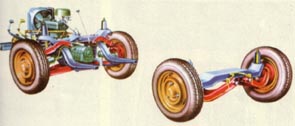
The rear axle is divided, made of a brace bearing a simple sheet metal
triangular arm. A joint low mounted pin was not used because on vehicles which
centre of gravity is variable depending on the load was it not suitable to place
the tilting centre of the rear suspension too high. Tilting half-axles are
beared on helical springs telescopic shock absorbers inside. The suspender pins
are mounted in rubber bushes. Suspension correctors at the end of the stroke are
made of rubber stops. The suspension yielding of the Estafette model is 14,3 mm;
Traffic 17 mm; ambulance 36 mm/100 kg. The useful load of Estafette model is 600
of Traffic 500 kg. The Traffic model has only weak springs, was designed just
with this load, because at the time of his rice in Paris a traffic limit for
vehicles with load over 0,5t at definite hours was valid.
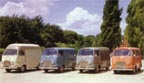
In 1958 he was introduced to the public with an engine of 850 cc from the
Renault Dauphine. The Renault Estafette was placed in the segment between the
Renault Juvaquatre, Renault Dauphinoise and Renault Voltigeur, Goulette and
Galion.
The Estafette become a new gearbox with four synchronised accelerations. He has
an dry one-disc-clutch with 6 depressing springs. The cylinders are inserted.
The crankshaft is equipped with 3 main bearings, cylinder heads are of light
alloy. At compression stage 8 is the output 32 HP at 4,350 r.p.m. The max.
turning moment is reached at 2,000 r.p.m. Gravity carburetor Solex 28 DIT has no
acceleration pump. Ignition is equipped with both centrifugal- and
vacuum-controlled advance. The gearbox is of a special construction. There is a
hollow main shaft positioned over the main differential axle and has on its ends
an bevel pinion. Through the hollow passes the clutch shaft which is at once a
torsional vibration absorber. This unused arrangement made possible the direct
drive, i.e. the continuous coupling of clutch shaft with the bevel pinion quite
as at a classic gear box. The countershaft is seated in needle bearings. The
bevel gearing is hypoid and the motor ratio is 25,65 - 13,5 - 6,5 - 3,5 % and at
1,000 r.p.m. a speed 4,6 - 7,7 - 12,9 - 20 km/h.
The bottom gear and the second gear are very sort, there fore the Estafette can
clime mountains until 23.5 % with a 600 kg load. In 1961 the 850 cc engine was
replaced for the 1.100 cc Sierra engine of the Renault 8. In 1969 the 1.100 cc
Sierra engine was replaced by the 1.289 cc engine. Not only stronger, but also
faster became the Estafette. His top speed was 98 km/u. Consumption of the new
engine was about 10 l/100 km.
Also the interior of the driver was changed. The chairs, the dashboard, the
heating and air ventilation system become much better. On the outside the
bumpers were bigger and stronger, and become lager rubber blocks. So he was
better prepared to do his job in the city. In 1972 the front of the Estafette
was changed. A new whim of the radiator and the air circulation above the front
shield disappear.
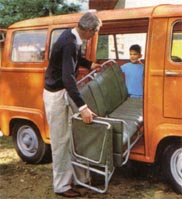
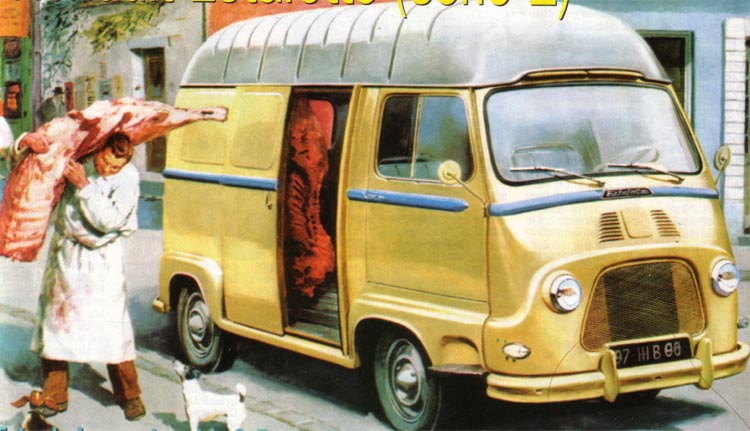
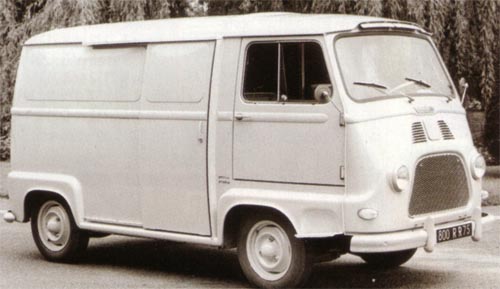
The Renault Estafette 800 and 1000 was build in many forms of bodywork. Long one
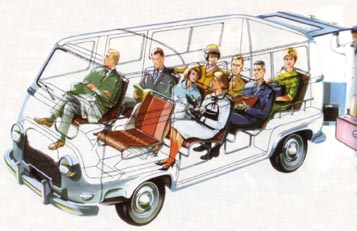
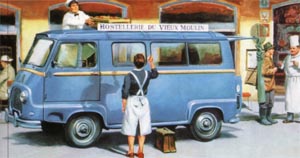
or short, with or without a high roof, Pick-up, Camper, Microbus and Alouette.
This was a small coach for 8 people. Famous is the Estafette with the high roof.
The Estafette with the high roof was designed by the gentleman d’Ariveau. It was
the first automatic production of polyester products of Renault.
To be mentioned are the front doors. The driver's ones are slid able backwards,
they may be let opened during the run. Doors of the co-driver were also possible
with slid able doors. These are exceptional.
During his live the Renault Estafette has competition of the Citroen HY, Fiat
238, Peugeot J5/J7, Volkswagen Transporter, Ford Transit and Barkas from the
DDR.
In the USA the delivery was called “Petit Panel” and the one with the high roof
as “ Hi boy”. The Pick-up as “Petit Wagon” and the Microcar as “Petit Wagon”. We
don’t know if there are Renault Estafettes in the USA.
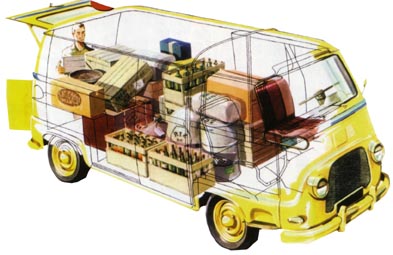
In 1980 was the end of the production of the Estafette. The Renault Traffic an
Master where the successor of the Renault Estafette.*
*i pumped this from neatherlands estafette
club site |








